
Frequently Asked Questions

Yes. In many cases, patients with dry eyes can still be suitable candidates for Lens Replacement Surgery, also known as Refractive Lens Exchange (RLE). If you are considering Lens Replacement Surgery abroad in Prague, your eye surgeon will carefully assess the health of your tear film during your comprehensive pre-operative examination. A healthy ocular surface is essential for obtaining accurate measurements before surgery, and many patients benefit from using preservative-free artificial tears before travelling to Prague. The same principles also apply to modern Cataract Surgery.
What Is Dry Eye Syndrome?
Dry Eye Syndrome is a common condition in which the eyes do not produce enough tears or the tears evaporate too quickly. It becomes increasingly common after the age of 45 and may cause:
- Dryness or irritation
- Burning or stinging eyes
- Redness
- Blurred or fluctuating vision
- A gritty or sandy sensation
- Excessive watering of the eyes
Many patients considering Lens Replacement Surgery or Cataract Surgery experience some degree of dry eye.
Can I Still Be Suitable for Lens Replacement Surgery?
Yes. In most cases, mild to moderate Dry Eye Syndrome does not prevent you from having Lens Replacement Surgery. Before recommending surgery, your eye surgeon will carefully examine the surface of your eyes and determine whether any treatment is required to optimise your tear film before proceeding. The final decision is always based on your individual eyes—not on a standard treatment plan.
Why Are Healthy Eyes Important Before Surgery?
A stable tear film is essential for obtaining accurate measurements before Lens Replacement Surgery. Your refractive eye surgeon uses these measurements to calculate the power of your new intraocular lens (IOL). If the surface of the eye is too dry, the measurements may be less accurate, potentially affecting the final visual result. For this reason, treating Dry Eye Syndrome before surgery helps achieve the most predictable long-term visual outcome.
Should I Use Artificial Tears Before Travelling to Prague?
In many cases, yes. If you already experience symptoms of dry eyes, we often recommend using preservative-free artificial tear drops for several weeks before your comprehensive eye examination in Prague. Many of our international patients are advised to use lubricating eye drops up to five times a day before travelling. Keeping the surface of the eye well hydrated helps ensure that your cornea is in the best possible condition for accurate diagnostic measurements. Your English-speaking Patient Coordinator will advise you before your trip if this recommendation applies to your individual situation.
How Do We Assess Dry Eyes?
Every patient undergoes a comprehensive 2–3 hour eye examination before surgery in Prague. During your assessment, your eye surgeon evaluates:
- Tear film quality
- Corneal health
- Ocular surface condition
- Corneal measurements
- Biometric measurements
- Retinal health
- Overall suitability for surgery
These detailed examinations help determine whether any treatment should be recommended before your Lens Replacement Surgery.
Will Lens Replacement Surgery Make Dry Eyes Worse?
Some patients notice temporary dryness during the first few weeks after surgery. This is a normal part of the healing process and usually improves as the eyes recover. Your surgeon will recommend the appropriate lubricating eye drops together with your prescribed post-operative medications to keep your eyes comfortable during recovery.
Can Dry Eyes Affect My Vision After Surgery?
Yes. Dry eyes can temporarily reduce the quality of your vision, causing fluctuations in clarity, particularly during the early healing period. This does not usually mean there is a problem with the surgery itself. In most patients, vision becomes more stable as the surface of the eye heals and the tear film improves.
Can I Still Have Premium Trifocal or EDOF Lenses?
In many cases, yes. Having Dry Eye Syndrome does not automatically mean you cannot benefit from premium Trifocal, EDOF (Vivity) or Monofocal intraocular lenses. Following your comprehensive eye examination, your surgeon will recommend the lens that best matches your eye health, lifestyle and visual expectations.
How Can I Prepare My Eyes Before My Examination?
To help achieve the most accurate measurements before surgery, we may recommend that you:
- Use preservative-free artificial tear drops for several weeks before your examination.
- Apply the drops up to five times daily, if recommended.
- Stop wearing contact lenses at least five days before your examination.
- Follow any additional recommendations provided by your Patient Coordinator before travelling to Prague.
Does Dry Eye Treatment Cost Extra?
Artificial tear drops are inexpensive and are usually purchased before travelling to Prague. If additional treatment is required, your eye surgeon will discuss the most appropriate options during your comprehensive examination. Our goal is always to optimise the surface of your eyes before surgery to achieve the best possible visual outcome.
Frequently Asked Questions
Can dry eyes stop me from having Lens Replacement Surgery?
Usually not. Most patients with mild or moderate Dry Eye Syndrome can still undergo Lens Replacement Surgery once the surface of the eye has been optimised.
Should I use artificial tears before surgery?
Many patients benefit from using preservative-free artificial tears before surgery, particularly if they have symptoms of Dry Eye Syndrome. Your Patient Coordinator or eye surgeon will advise you if this is recommended in your case.
How often should I use artificial tears?
If recommended, many of our international patients use preservative-free artificial tears up to five times a day before their comprehensive eye examination in Prague.
Are dry eyes common after Lens Replacement Surgery?
Temporary dryness is relatively common during the early healing period and usually improves over the following weeks with the use of lubricating eye drops and normal healing.
Can I Have Cataract Surgery If I Have Dry Eyes?
Yes. The same principles apply to Cataract Surgery. Optimising the tear film before surgery helps improve the accuracy of measurements and contributes to the best possible visual outcome.
Final Thoughts
Having Dry Eye Syndrome does not usually prevent you from having Lens Replacement Surgery, Refractive Lens Exchange (RLE) or Cataract Surgery. By identifying and treating dry eyes before surgery, your eye surgeon can obtain more accurate measurements and recommend the most appropriate intraocular lens for your individual eyes.
Following your comprehensive 2–3 hour diagnostic assessment in Prague, you will receive a personalised treatment plan based on your eye health, lifestyle and visual goals.
Apply for a free email consultation by clicking on the button FREE CONSULTATION or contact us, SEND YOUR PRESCRIPTION via Whatsapp at +420 775 178 715.
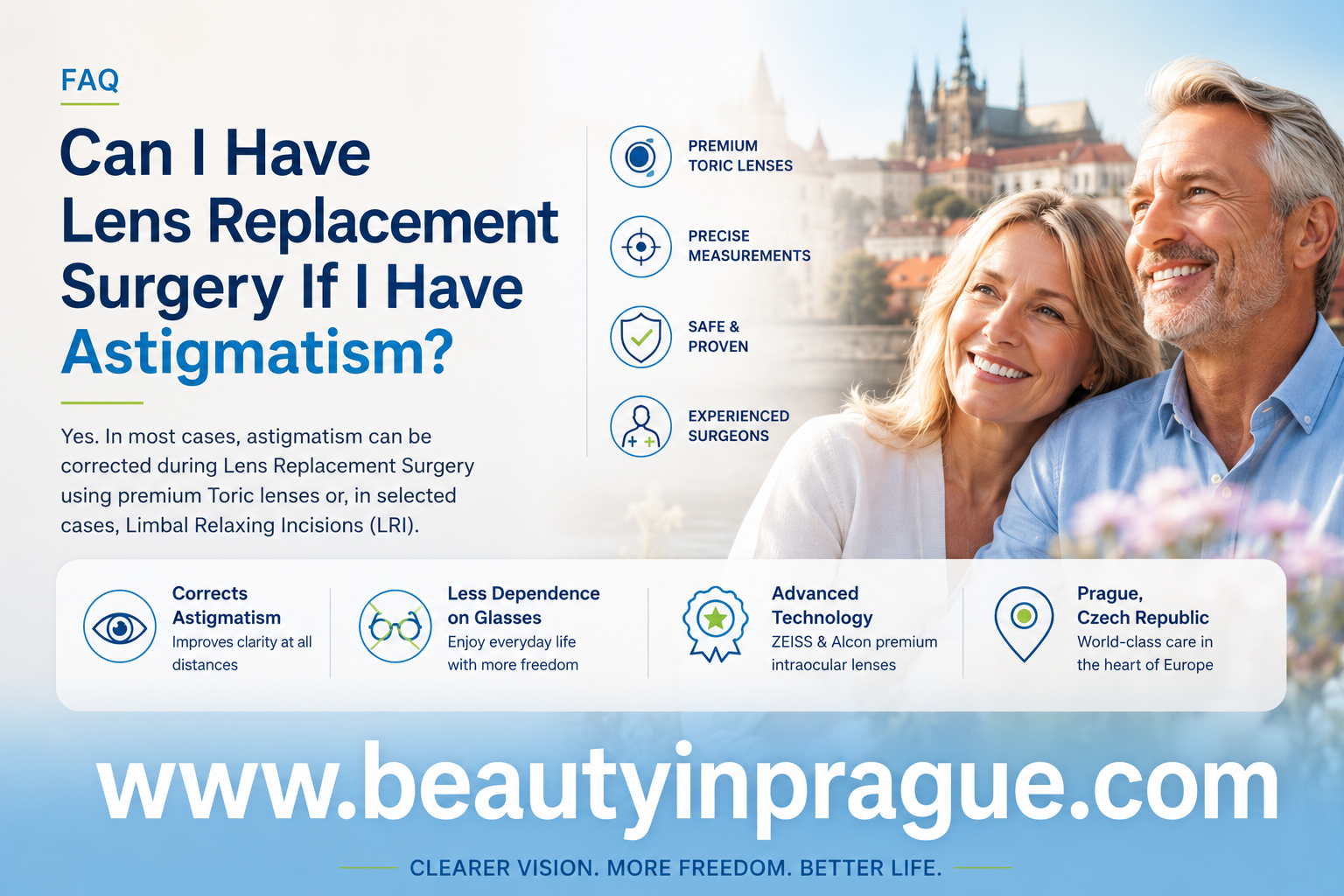
Yes. In most cases, patients with astigmatism can still have Lens Replacement Surgery, also known as Refractive Lens Exchange (RLE). During your comprehensive pre-operative assessment in Prague, your eye surgeon will measure the type and degree of your astigmatism and recommend the most appropriate treatment. Depending on your individual eyes, astigmatism may be corrected using a premium toric intraocular lens (Toric IOL) or, in selected cases, limbal relaxing incisions (LRI). The same techniques are commonly used during cataract surgery.
What Is Astigmatism?
Astigmatism is a common refractive error caused by an irregularly shaped cornea or, less commonly, the natural lens inside the eye. Instead of focusing light evenly on the retina, the eye produces blurred or distorted vision at different distances.
Many people with astigmatism also have:
- Short-sightedness (myopia)
- Long-sightedness (hyperopia)
- Presbyopia (age-related need for reading glasses)
Fortunately, these conditions can often be addressed during Lens Replacement Surgery.
How Is Astigmatism Corrected During Lens Replacement Surgery?
- Low astigmatism → in selected patients it may be corrected with Limbal Relaxing Incisions (LRI) performed during surgery.
- Moderate to high astigmatism → a premium Toric IOL is usually recommended.
- The final choice depends on detailed measurements taken during your 2–3 hour diagnostic examination
Depending on your individual visual needs, toric lenses are available as:
- Toric Monofocal lenses
- Toric EDOF (Extended Depth of Focus) lenses
- Toric Trifocal lenses
Your eye surgeon will recommend the most appropriate option after your 2-3 hours comprehensive eye examination.
We use premium Toric intraocular lenses from globally recognised manufacturers, including ZEISS and Alcon.
In 2026, our refractive and cataract surgeon MUDr. Andrea Janeková, FEBO, FEBOS-CR, was selected by ZEISS Medical Technology to perform one of the world’s first implantations of the new ZEISS AT LUCIA Toric intraocular lens. This international recognition reflects her extensive experience in astigmatism correction, cataract surgery and lens replacement surgery.
How Do We Know If I Need a Toric Lens?
Every patient undergoes a 2–3 hour comprehensive diagnostic eye assessment before surgery in Prague, usually on Monday morning. During your examination, we perform detailed measurements of your eyes using advanced diagnostic technology, including corneal mapping and biometric measurements. Your results are then carefully reviewed by an experienced eye surgeon, who will recommend the lens that offers the best balance of visual quality, lifestyle needs and long-term results. The final decision is always based on your individual eyes—not on a standard treatment plan.
Why Is a Comprehensive Eye Examination So Important?
Selecting the correct Toric lens is not based on your glasses prescription alone. Your surgeon evaluates multiple factors including corneal curvature, the amount and axis of astigmatism, eye health, pupil size, retinal health and your lifestyle. This personalised approach helps achieve the most predictable long-term visual outcome
Can I Wear Contact Lenses Before My Examination?
To ensure the most accurate measurements for your intraocular lens (IOL), you should stop wearing contact lenses at least five days before your comprehensive eye examination in Prague. Contact lenses can temporarily alter the shape of the cornea, which may affect the accuracy of the measurements used to select your new lens.
Will Lens Replacement Surgery Completely Eliminate My Astigmatism?
Many patients achieve a significant reduction in astigmatism after surgery and enjoy much clearer vision without relying on glasses. However, the results depend on several factors, including:
- the amount of astigmatism
- the health of your eyes
- the type of intraocular lens selected
- your individual healing process
Your surgeon will discuss the expected outcome during your consultation and explain what level of vision you can realistically expect.
Is Astigmatism Treated the Same Way During Cataract Surgery?
Yes. The principles are very similar because both Lens Replacement Surgery (Refractive Lens Exchange) and Cataract Surgery replace the eye’s natural lens with an artificial intraocular lens (IOL). If a patient has significant astigmatism, a premium toric lens may be recommended during either procedure to improve vision and reduce dependence on glasses.
Can I Still Be Suitable for Premium Trifocal Lenses?
In many cases, yes. Patients with astigmatism can often benefit from premium Toric Trifocal lenses, allowing them to enjoy clear distance, intermediate and near vision while also correcting astigmatism. The suitability of trifocal lenses depends on your eye health, the amount of astigmatism and your lifestyle requirements. During your consultation, your surgeon will explain whether a Toric Trifocal lens, Toric EDOF lens or another option is most appropriate for you.
Does Astigmatism Make Lens Replacement Surgery More Expensive?
Not necessarily. The cost depends on the amount of astigmatism and the treatment recommended by your eye surgeon following your comprehensive pre-operative assessment. Patients with minor astigmatism may be suitable for Limbal Relaxing Incisions (LRI), performed during surgery to reduce astigmatism.
- LRI (Limbal Relaxing Incisions): €120 (£110) per eye
Patients with moderate or higher astigmatism usually benefit from a premium Toric intraocular lens (Toric IOL). Depending on your visual needs, Toric lenses are available as Monofocal, EDOF (Vivity) or Trifocal lenses.
Our current package for Lens replacement prices with premium Toric lenses include:
- Monofocal Toric lenses in both eyes: €2,400 (£2,150)
- One Monofocal Toric lens + one Monofocal lens: €2,200 (£2,000)
- One Trifocal Toric (or Vivity Toric) lens + one Trifocal (or Vivity) lens: €3,850 (£3,400)
- Trifocal Toric (or Vivity Toric) lenses in both eyes: €4,100 (£3,600)
All Lens replacement surgery package prices include your comprehensive eye examination, surgeon consultation, surgery, premium intraocular lenses, post-operative care, airport transfers and complimentary taxi transfers between your hotel and the eye clinic during your stay in Prague.
Every patient is different. For this reason, we do not recommend a particular lens or treatment before your comprehensive eye examination in Prague. Following your 2–3 hour diagnostic assessment, your eye surgeon will determine whether you are suitable for Monofocal, Toric, EDOF (Vivity) or Trifocal lenses, or whether another treatment option would provide the best long-term visual outcome. You will then receive a personalised treatment plan together with a fixed quotation, so you know exactly what is included before making your decision.
Can Astigmatism Come Back After Lens Replacement Surgery?
The astigmatism corrected during surgery does not usually return. However, your vision may change over time because of other age-related eye conditions or changes to the cornea. During your follow-up examinations, your eye specialist will monitor your vision and eye health.
Frequently Asked Questions
Can astigmatism be corrected during Lens Replacement Surgery?
Yes. Most patients with astigmatism can be treated using a premium toric intraocular lens specifically designed to correct astigmatism.
Are toric lenses worth it?
For patients with clinically significant astigmatism, toric lenses can provide sharper vision and reduce dependence on glasses compared with standard intraocular lenses.
Will I still need glasses if I have astigmatism?
Many patients become much less dependent on glasses after surgery. However, the outcome depends on your eyes, the type of lens selected and your individual visual goals.
Is a toric lens used during cataract surgery?
Yes. Premium toric intraocular lenses are commonly used during cataract surgery as well as refractive lens exchange to correct astigmatism.
Not sure whether your astigmatism can be corrected?
Send us your glasses prescription or your latest eye examination results. Our English-speaking Patient Coordinator will arrange a free surgeon pre-assessment before you travel to Prague. After your comprehensive eye examination, your surgeon will recommend the most appropriate treatment and explain all available lens options.
Apply for a free email consultation by clicking on the button FREE CONSULTATION or contact us, SEND YOUR PRESCRIPTION via Whatsapp at +420 775 178 715.

ANSWER
Many patients considering Lens Replacement Surgery abroad ask what is included in the treatment price and whether there are any additional costs.
At our eye clinic in Prague, we offer an all-inclusive treatment package for Lens Replacement surgery (known also as RLE – Refractive Lens Exchange) designed to make the entire process simple, comfortable and stress-free for international patients. Our package includes not only the surgery itself, but also examinations, premium lenses, post-operative care, transfers and ongoing support.
Patients travelling from the UK, Ireland, USA, Canada, Australia and New Zealand appreciate knowing exactly what is included before they travel, with no hidden costs or unexpected fees.
What Is Included in the Price?
✔ Comprehensive 2–3 hour diagnostic eye examination and consultation
✔ Personalised treatment planning by an experienced refractive eye surgeon
✔ Premium intraocular lenses from leading manufacturers such as ZEISS and Alcon
✔ Lens Replacement Surgery in both eyes
✔ Customised lens selection based on your visual needs and lifestyle
✔ Post-operative examinations and check-ups during your stay in Prague
✔ Complimentary anti-inflammatory and other essential eye drops to support healing
✔ Detailed post-operative instructions
✔ Complimentary airport transfers to and from Prague Airport
✔ Complimentary transfers between your accommodation and the eye clinic (Prague 1 and Prague 7)
✔ Hotel and apartment recommendations based on your preferences and budget
✔ Dedicated English-speaking patient coordinators available before, during and after treatment
✔ Ongoing support throughout your recovery
No Hidden Costs
Unlike some providers, our lens replacement surggery prices are designed to be transparent and all-inclusive.
Many eye clinics charge separately for consultations, eye examinations, transfers or post-operative care. At our eye clinic in Prague, these services are already included in the treatment price, helping patients avoid unexpected costs.
Our complimentary airport transfers and clinic transfers alone can save patients approximately £120 (€150) during their stay in Prague.
Lens Replacement Surgery Prices in Prague
Monofocal Lenses
✔ Monofocal Lenses (both eyes) – €1,900 (£1,750)
Monofocal Toric Lenses
✔ Monofocal Toric Lenses (both eyes) – €2,400 (£2,150)
Trifocal Lenses
✔ Trifocal Lenses (both eyes) – €3,400 (£3,000)
Trifocal Toric Lens in One Eye + Trifocal Lens in the Second Eye
✔ €3,850 (£3,400)
Trifocal Toric Lenses in Both Eyes
✔ €4,100 (£3,600)
Most of our patients are suitable candidates for premium trifocal lenses, which provide the highest level of glasses independence after Lens Replacement Surgery. The final recommendation is always made after a comprehensive eye examination and consultation with an eye doctor in Prague.
Payment Information
Patients can pay in Euros (€) or British Pounds (£) in cash.
Card payments are also accepted. For card payments, the clinic applies a fixed exchange rate of 27 CZK per €1.
Why Patients Choose Lens Replacement Surgery in Prague
✔ Premium ZEISS and Alcon lenses
✔ No waiting lists
✔ Both eyes typically treated on the same day
✔ Comprehensive 2–3 hour diagnostic eye examination
✔ Experienced refractive eye surgeons
✔ More than 100,000 intraocular procedures performed
✔ Complimentary airport transfers
✔ Complimentary eye clinic transfers
✔ Comprehensive post-operative care and check-ups
✔ Dedicated English-speaking patient coordinators
✔ Patients from the UK, Ireland, USA, Canada, Australia and New Zealand
✔ Affordable Lens Replacement Surgery abroad in Prague
Free Online Consultation
Before travelling to Prague, patients can take advantage of our free online consultation.
Simply complete our medical questionnaire and send us your glasses prescription. Our medical team and refractive eye surgeons can often provide an initial opinion on whether Lens Replacement Surgery may be suitable for you and which lens type may be the best option.
The final treatment plan and lens recommendation are always confirmed after the detailed eye examination and consultation in Prague.
Many patients are pleasantly surprised to discover that Lens Replacement Surgery in Prague often costs significantly less than in the UK while still providing access to experienced surgeons, premium ZEISS and Alcon lenses, modern technology and comprehensive aftercare.
Apply for a free email consultation by clicking on the button FREE CONSULTATION or contact us, SEND YOUR PRESCRIPTION via Whatsapp at +420 775 178 715.

ANSWER
One of the most important decisions when considering Lens Replacement Surgery (also known as RLE – Refractive Lens Exchange) is choosing the most suitable intraocular lens (IOL). The two most popular premium lens options are Trifocal Lenses and EDOF (Extended Depth of Focus) Lenses.
Both lens types can significantly reduce dependence on glasses, but they are designed for slightly different visual needs and lifestyles.
Trifocal Lenses
Trifocal lenses are designed to provide clear vision at three distances:
✔ Distance vision
✔ Intermediate vision (computer, dashboard)
✔ Near vision (reading, smartphone)
Because trifocal lenses provide vision across all three ranges, they offer the highest level of glasses independence after Lens Replacement Surgery.
Most patients with trifocal lenses can comfortably perform everyday activities such as reading, using a smartphone, working on a computer, driving and watching television without glasses.
For this reason, trifocal lenses are the most popular choice among our patients travelling abroad to Prague for Lens Replacement Surgery.
Approximately 90% of our patients are suitable candidates for premium trifocal lenses.
EDOF Lenses
EDOF stands for Extended Depth of Focus.
Unlike trifocal lenses, EDOF lenses do not split light into three separate focal points. Instead, they create an extended range of vision with a strong emphasis on distance and intermediate vision.
Patients with EDOF lenses can usually enjoy:
✔ Excellent distance vision
✔ Excellent computer and intermediate vision
✔ Functional near vision
✔ High visual quality
✔ Reduced glare and halo effects
Many patients can comfortably perform daily activities without glasses, including driving, using a laptop, watching television and reading menus or messages on their phone.
However, some patients may still occasionally require weak reading glasses for very small print or prolonged reading.
Why Would Someone Choose EDOF Instead of Trifocal Lenses?
Although trifocal lenses provide the greatest level of glasses independence, they are not always the best option for every patient.
EDOF lenses may be recommended for patients who:
✔ Have undergone previous laser eye surgery (LASIK, LASEK or PRK)
✔ Have certain corneal irregularities or scars
✔ Have specific retinal or eye conditions
✔ Prioritise high-quality night vision
✔ Prefer minimal halo and glare effects
For these patients, EDOF lenses can often provide excellent visual outcomes while maintaining exceptional visual quality.
Halo Effects and Neuroadaptation
Patients considering premium trifocal lenses often ask about halos around lights at night.
Halo effects are a normal part of the neuroadaptation process. During the first weeks or months after surgery, the brain gradually learns how to process visual information from the new lenses and adapt to multiple focal distances.
Most patients find that halos become significantly less noticeable over time as adaptation progresses.
Which Lens Is Best?
There is no single lens that is best for everyone.
For most patients over the age of 45 who wear glasses for both distance and reading, premium trifocal lenses offer the highest level of glasses independence and are therefore the most common choice.
However, some patients may achieve better results with EDOF lenses depending on their eye condition, previous eye surgery, lifestyle and visual expectations.
Free Assessment Before Travelling to Prague
Before travelling abroad for Lens Replacement Surgery in Prague, patients can take advantage of our free email consultation.
Simply complete our medical questionnaire and send us your glasses prescription. Our medical team and refractive eye surgeon can often provide an initial opinion on whether trifocal lenses or EDOF lenses may be more suitable.
The final recommendation is always confirmed during a comprehensive 2–3 hour eye examination, measurements and consultation with an eye doctor in Prague.
Why Patients Choose Prague for Lens Replacement Surgery
✔ Premium trifocal and EDOF lenses available
✔ Approximately 90% of patients are suitable candidates for trifocal lenses
✔ Free email consultation before travelling
✔ Comprehensive 2–3 hour eye examination
✔ Experienced refractive eye surgeons
✔ More than 100,000 intraocular procedures performed
✔ Patients from the UK, Ireland, USA, Canada, Australia and New Zealand
Choosing the right lens is one of the most important parts of Lens Replacement Surgery. Our goal is to recommend the lens that will provide the best possible vision and lifestyle benefits for each individual patient.
Apply for a free email consultation by clicking on the button FREE CONSULTATION or contact us, SEND YOUR PRESCRIPTION via Whatsapp at +420 775 178 715.

ANSWER
One of the most common questions patients ask is whether they are too young or too old for Lens Replacement Surgery (also known as RLE – Refractive Lens Exchange). The good news is that there is no single “perfect age” for the procedure. Instead, suitability depends on your vision, lifestyle, eye health and visual goals.
Who Is the Ideal Candidate for Lens Replacement Surgery?
The ideal candidate for Lens Replacement Surgery is typically aged 45 or over and relies on glasses for both distance and reading vision.
Many patients in their late 40s, 50s and 60s find themselves constantly switching between different pairs of glasses or wearing varifocals throughout the day. These patients often achieve the greatest benefit from Lens Replacement Surgery and premium trifocal lenses.
However, age alone does not determine whether someone is a suitable candidate.
Some patients over 45 may still have very good distance vision and only require weak reading glasses. In these cases, Lens Replacement Surgery may not yet provide sufficient benefit and waiting a few more years can sometimes be the better option.
Likewise, patients under the age of 45 are often considered too young for Lens Replacement Surgery. Because the procedure permanently replaces the natural lens and is generally performed only once in a lifetime, our surgeons aim to recommend it at the stage when it can provide the greatest long-term benefit and best possible visual outcome.
For this reason, Lens Replacement Surgery is most commonly performed in patients in their 50s, 60s and 70s who wear glasses for both distance and reading and wish to achieve greater independence from glasses.
Why Is Lens Replacement Surgery Popular After Age 45?
From around the age of 45, the natural lens inside the eye gradually loses its ability to focus at different distances. This is known as presbyopia and is the reason many people begin needing reading glasses.
As patients move into their late 40s, 50s and 60s, they often become increasingly dependent on glasses for both near and distance vision.
Unlike laser eye surgery, which reshapes the cornea, Lens Replacement Surgery replaces the ageing natural lens with a modern artificial intraocular lens (IOL). This allows surgeons to correct multiple vision problems at the same time, including:
✔ Reading vision (presbyopia)
✔ Long-sightedness
✔ Short-sightedness
✔ Astigmatism
✔ Future cataracts
Because the natural lens is removed, cataracts cannot develop in the future.
Which Lens Is Best for My Age?
Patients travelling abroad to Prague for Lens Replacement Surgery can choose from several types of premium intraocular lenses.
Trifocal Lenses
Premium trifocal lenses are the most popular choice among our international patients because they provide vision at near, intermediate and distance ranges.
Approximately 90% of our patients are suitable candidates for trifocal lenses. These lenses offer the highest level of glasses independence and allow most patients to perform everyday activities such as reading, using a smartphone, working on a computer, driving and watching television without glasses.
EDOF Lenses
EDOF (Extended Depth of Focus) lenses are often recommended for patients who may not be ideal candidates for trifocal lenses, for example following previous laser eye surgery or in the presence of certain corneal conditions.
They provide excellent distance and intermediate vision and often produce fewer halos and glare, although some patients may still require weak reading glasses for very small print.
Monofocal Lenses
Monofocal lenses provide excellent vision at one selected distance, but most patients will still require reading glasses for near tasks.
Free Assessment Before Travelling to Prague
Before travelling abroad for Lens Replacement Surgery in Prague, patients can take advantage of our free email consultation.
Simply complete our medical questionnaire and send us your glasses prescription. Our medical team and refractive eye surgeon can often provide an initial opinion on whether you are likely to be a suitable candidate for Lens Replacement Surgery and whether premium trifocal lenses may be appropriate.
The final recommendation is always confirmed during a comprehensive 2–3 hour eye examination, measurements and consultation with an eye doctor in Prague.
Based on your eye health, lifestyle and visual expectations, we will recommend the most suitable lens option for your individual needs.
Why Patients Choose Lens Replacement Surgery in Prague
✔ Ideal for patients aged 45+ who wear glasses for both distance and reading
✔ Premium trifocal, EDOF and monofocal lenses available
✔ Approximately 90% of patients are suitable candidates for trifocal lenses
✔ Free email consultation before travelling
✔ Comprehensive 2–3 hour eye examination
✔ Experienced refractive eye surgeons
✔ More than 100,000 intraocular procedures performed
✔ Patients from the UK, Ireland, USA, Canada, Australia and New Zealand
✔ Affordable Lens Replacement Surgery abroad in Prague
If you are over 45 and rely on glasses for both distance and reading, Lens Replacement Surgery may offer a long-term solution and greater visual freedom. The best way to determine whether you are a suitable candidate is through a comprehensive eye examination and consultation with an experienced refractive eye surgeon.
Real Patient Experiences
We invite you to watch our patient video reviews and learn how Lens Replacement Surgery has helped patients from around the world achieve greater visual freedom and reduce their dependence on glasses.
If you are over 45 and rely on glasses for both distance and reading, Lens Replacement Surgery may offer a long-term solution and greater visual freedom. The best way to determine whether you are a suitable candidate is through a comprehensive eye examination and consultation with an experienced refractive eye surgeon.
Apply for a free email consultation by clicking on the button FREE CONSULTATION or contact us, SEND YOUR PRESCRIPTION via Whatsapp at +420 775 178 715.

ANSWER
Many patients choose Lens Replacement Surgery because they want to reduce or eliminate their dependence on glasses. Whether you will need glasses after surgery depends primarily on the type of intraocular lens (IOL) selected for your treatment.
Most patients considering Lens Replacement Surgery (also known as RLE – Refractive Lens Exchange) are aged 45 and over and already wear glasses for both distance and reading. One of the main goals of the procedure is to reduce or completely eliminate the need for glasses in everyday life.
Patients travelling abroad to Prague (Czech republic) for Lens Replacement Surgery can choose from several types of premium lenses, each offering different visual benefits.
Trifocal Lenses
Premium trifocal lenses are designed to provide clear vision at near, intermediate and distance ranges. Most patients with trifocal lenses can comfortably perform everyday activities such as reading, using a computer, driving and watching television without glasses.
Many patients describe the feeling of being able to see both near and far without constantly searching for reading glasses as one of the greatest benefits of Lens Replacement Surgery.
Approximately 90% of our patients are suitable candidates for premium trifocal lenses. These lenses offer the highest level of glasses independence and are therefore the most popular choice among patients travelling to Prague for Lens Replacement Surgery.
EDOF Lenses
EDOF (Extended Depth of Focus) lenses provide excellent distance and intermediate vision and are often chosen by patients who prioritise high-quality vision and night driving.
They may also be recommended for patients who are not suitable candidates for trifocal lenses, for example following previous laser eye surgery or in the presence of certain corneal conditions. EDOF lenses often produce fewer halos and glare than trifocal lenses while maintaining excellent visual quality.
Some patients may still occasionally require weak reading glasses for very small print or prolonged reading.
Monofocal Lenses
Monofocal lenses provide excellent vision at one selected distance, typically for driving and everyday activities. However, most patients will still require reading glasses for close-up tasks such as reading books, menus, newspapers or text messages.
Our Goal Is Maximum Glasses Independence
During your comprehensive 2–3 hour eye examination in Prague, our eye surgeons and medical team will discuss your lifestyle, hobbies, profession and visual expectations to help determine the most suitable lens for you.
Before travelling to Prague, patients can also take advantage of our free email consultation. After completing a medical questionnaire and sending us their glasses prescription, our medical team and refractive eye surgeon can often provide an initial opinion on whether trifocal lenses are likely to be suitable.
The final recommendation and lens selection are always confirmed after the detailed eye examination, measurements and consultation with an eye doctor in Prague. Based on your eye health, lifestyle and visual expectations, we will recommend the most suitable lens option for your individual needs.
Many international patients travelling from the UK, Ireland, USA, Canada, Australia and New Zealand choose premium trifocal lenses because they offer the highest level of glasses independence after Lens Replacement Surgery.
While no refractive eye surgeon can guarantee complete freedom from glasses in every situation, modern premium intraocular lenses allow most patients to significantly reduce or completely eliminate their need for glasses in daily life.
Why Patients Travel to Prague for Lens Replacement Surgery
✔ Premium trifocal, EDOF and monofocal lenses available
✔ Approximately 90% of patients are suitable candidates for trifocal lenses
✔ Free email consultation before travelling to Prague
✔ Both eyes typically treated on the same day
✔ Comprehensive 2–3 hour eye examination
✔ Experienced refractive eye surgeons
✔ More than 100,000 intraocular procedures performed
✔ Patients from the UK, Ireland, USA, Canada, Australia and New Zealand
✔ Affordable Lens Replacement Surgery abroad in Prague
Many patients report that one of the most rewarding outcomes of Lens Replacement Surgery is being able to enjoy everyday life without constantly relying on reading glasses, varifocals or bifocals.
Real Patient Experiences
Many of our patients share their experiences after Lens Replacement Surgery and describe how their dependence on glasses has been significantly reduced or eliminated. Some patients report being able to read, use a smartphone, drive and enjoy everyday activities without glasses for the first time in many years.
We invite you to watch our patient video reviews to learn more about their experience, recovery and visual outcomes after Lens Replacement Surgery abroad in Prague.
Watch Lens Replacement Surgery Abroad Reviews
Joseph from the UK: Trifocal Lens replacement surgery in Prague:
Sharon from the UK: Trifocal Lens replacement surgery abroad in Prague:
Apply for a free email consultation by clicking on the button FREE CONSULTATION or contact us, SEND YOUR PRESCRIPTION via Whatsapp at +420 775 178 715.

ANSWER
No. Cataracts cannot return after Lens Replacement Surgery.
During Lens Replacement Surgery (also known as Refractive Lens Exchange or RLE), your natural lens is permanently removed and replaced with an artificial intraocular lens (IOL). Because cataracts develop in the natural lens, they cannot form again once that lens has been removed.
This is one of the major long-term benefits of Lens Replacement Surgery. In addition to correcting vision problems such as presbyopia, long-sightedness, short-sightedness and astigmatism, the procedure also eliminates the future risk of developing cataracts.
Some patients may later experience a condition called Posterior Capsule Opacification (PCO), sometimes referred to as a “secondary cataract”. Despite the name, this is not a true cataract. It occurs when the thin membrane behind the artificial lens becomes cloudy months or years after surgery.
PCO is one of the most common long-term side effects following cataract surgery and Lens Replacement Surgery. Fortunately, it can usually be treated quickly and painlessly with a YAG laser procedure, which typically takes only a few minutes.
At our eye clinic in Prague, YAG laser treatment for PCO is offered free of charge within one year of surgery as a complimentary service for our patients.
Why Patients Choose Lens Replacement Surgery Abroad
✔ Cataracts cannot return after the natural lens is removed
✔ Permanent vision correction
✔ Premium trifocal, EDOF and monofocal lenses
✔ Both eyes typically treated on the same day
✔ Future cataract surgery is no longer needed
✔ Patients from the UK, Ireland, USA, Canada, Australia and New Zealand
Many patients travelling abroad for Lens Replacement Surgery in Prague appreciate the fact that they are not only reducing their dependence on glasses but also eliminating the possibility of developing cataracts in the future.
Apply for a free email consultation by clicking on the button FREE CONSULTATION or contact us, SEND YOUR PRESCRIPTION via Whatsapp at +420 775 178 715.

ANSWER
Like any surgical procedure, Lens Replacement Surgery carries some risks. Fortunately, serious complications are rare, particularly when the procedure is performed by experienced surgeons and following a comprehensive pre-operative examination.
Patients considering Lens Replacement Surgery abroad (also known as RLE – Refractive Lens Exchange) often ask about potential risks before travelling to Prague for treatment. The good news is that modern Lens Replacement Surgery is based on the same advanced techniques used in cataract surgery, one of the most commonly performed and successful procedures worldwide.
Possible complications may include:
Posterior Capsule Opacification (PCO)
PCO is the most common long-term complication after Lens Replacement Surgery. It occurs when the membrane behind the artificial lens becomes cloudy months or years after surgery. PCO is not dangerous and can usually be corrected with a quick, painless YAG laser treatment that takes only a few minutes. At our clinic, this treatment is offered free of charge within one year of surgery as a complimentary service for our clients.
Cystoid Macular Oedema (CME)
CME is a rare swelling of the central retina (macula). In most cases, it can be successfully treated with anti-inflammatory eye drops and careful monitoring.
Dry Eyes, Glare and Halo Effects
Some patients may notice temporary dry eyes, glare or halo effects around lights, particularly during the first weeks or months after surgery when adapting to premium trifocal lenses.
Halo effects are a normal part of the neuroadaptation process. During this period, the brain gradually learns how to process visual information from the new intraocular lenses and adapt to multiple focal distances. Most patients find that these visual phenomena become less noticeable over time as adaptation progresses.
The majority of patients successfully adapt to their new lenses and enjoy excellent vision at near, intermediate and distance ranges without relying on glasses.
How We Minimise the Risks of Lens Replacement Surgery
One of the most important factors in achieving excellent outcomes is surgeon experience, careful patient selection and comprehensive aftercare.
Our Prague refractive eye surgeons perform a detailed 2–3 hour pre-operative examination before Lens Replacement Surgery. This allows us to assess your eye health, take precise measurements and select the most suitable premium intraocular lens for your individual visual needs.
The procedure itself is performed under local anaesthesia using anaesthetic eye drops and typically takes only 10–15 minutes per eye. Both eyes are usually treated on the same day, making the treatment more convenient for patients travelling abroad to Prague for Lens Replacement Surgery.
Before Refractive Lens exchange surgery, patients receive detailed instructions explaining how to prepare for the procedure. After surgery, every patient receives comprehensive post-operative instructions together with a complimentary set of prescribed eye drops, including antibiotic and anti-inflammatory eye drops. These medications play an important role in reducing the risk of infection, supporting healing and helping to achieve the best possible visual outcome.
Before returning home, all patients attend a post-operative check-up the following day. During this appointment, our medical team performs a series of eye examinations and measurements to monitor healing, assess visual outcomes and check for any signs of complications. The results are reviewed by an eye doctor to ensure recovery is progressing as expected and that it is safe for the patient to travel home, including by air.
Patients are also advised how to care for their eyes during recovery. This includes avoiding rubbing the eyes, swimming pools, hot tubs, saunas, dusty environments and strenuous exercise for several weeks after surgery. Wearing sunglasses outdoors and following all post-operative instructions can help support a smooth recovery.
Based on many years of surgical experience, our surgeons prefer proven microsurgical techniques that provide excellent control throughout the procedure and consistently outstanding results.
For most patients, the benefits of Lens Replacement Surgery far outweigh the risks. The vast majority experience a smooth recovery and a significant improvement in vision, often within just a few days.
Patients from the UK, Ireland, USA, Canada, Australia and New Zealand regularly travel to Prague for Lens Replacement Surgery because of the combination of experienced surgeons, modern technology and comprehensive aftercare.
Apply for a free email consultation by clicking on the button FREE CONSULTATION or contact us, SEND YOUR PRESCRIPTION via Whatsapp at +420 775 178 715.

Answer
Yes. Lens Replacement Surgery abroad can be just as safe as treatment in your home country, provided you choose an experienced refractive eye surgeon, a reputable eye clinic and a destination with high medical standards.
Prague has become one of Europe’s leading destinations for Lens Replacement Surgery abroad, attracting patients from the UK, Ireland, USA, Canada, Australia and New Zealand who are looking for high-quality vision correction at affordable prices.
Lens Replacement Surgery (also known as Refractive Lens Exchange or RLE) is based on the same advanced techniques used in modern cataract surgery and is considered one of the safest and most effective procedures for correcting presbyopia, long-sightedness, short-sightedness and astigmatism.
At our Prague eye clinic, every patient undergoes a comprehensive 2–3 hour eye examination before surgery. Detailed measurements are taken to assess eye health and determine the most suitable premium intraocular lens (IOL) for each patient’s individual needs and lifestyle.
The procedure itself is performed under local anaesthesia using anaesthetic eye drops and typically takes only 10–15 minutes per eye. Both eyes are usually treated on the same day, making the recovery process quicker and more convenient for international patients travelling abroad for treatment.
One of the most important factors when considering Lens Replacement Surgery abroad is the experience and expertise of the surgeon. Our cooperating refractive eye surgeons actively participate in international ophthalmology congresses and educational programmes, including the ESCRS (European Society of Cataract and Refractive Surgeons) Congress, one of the most respected ophthalmology meetings in the world.
Dr Andrea Janeková, one of our leading refractive and cataract surgeons, was recognised by Forbes magazine as one of the Top 50 Doctors in the Czech Republic. She has performed more than 12,000 intraocular procedures, is certified by the European Board of Ophthalmology (FEBO) and holds the advanced FEBOS-CR qualification in cataract and refractive surgery.
We use premium intraocular lenses from internationally recognised manufacturers including Zeiss, Alcon and Lenstec. These modern lenses are designed to provide long-term vision correction and can help many patients significantly reduce or eliminate their dependence on glasses.
Why Patients Choose Lens Replacement Surgery Abroad in Prague
✔ More than 100,000 eye procedures performed by experienced eye surgeons
✔ Forbes-recognised refractive surgeon
✔ Premium trifocal, EDOF, toric and monofocal lenses
✔ Both eyes typically treated on the same day
✔ Local anaesthesia with no general anaesthetic required
✔ Comprehensive pre-operative and post-operative care
✔ Complimentary airport and clinic transfers
✔ English-speaking patient coordinators
✔ Patients from the UK, Ireland, USA, Canada, Australia and New Zealand
✔ Prague is only around 1 hour 30 minutes by flight from the UK and Ireland
Is Travelling Abroad for Lens Replacement Surgery Worth It?
Many patients choose Lens Replacement Surgery abroad because they can receive treatment from highly experienced surgeons while benefiting from shorter waiting times and significantly lower costs compared with private treatment in some countries.
For most international patients, the entire treatment journey can be completed during a short 4–5 day stay in Prague, including consultation, surgery and post-operative check-up before travelling home.
When performed by experienced surgeons using modern technology and premium intraocular lenses, Lens Replacement Surgery abroad is considered a safe, predictable and highly successful vision correction procedure.
Apply for a free email consultation by clicking on the button FREE CONSULTATION or contact us, SEND YOUR PRESCRIPTION via Whatsapp at +420 775 178 715.

ANSWER
No. Lens Replacement Surgery is not considered a painful procedure. The treatment is performed under local anaesthesia using anaesthetic eye drops, which numb the surface of the eye before surgery begins.
During the procedure, most patients feel little to no pain. You may notice lights, colours or slight pressure, but the surgery itself is generally comfortable. For patients who feel nervous, we can offer a mild anti-stress tablet (Lexaurin) before the procedure to help them relax.
Lens Replacement Surgery typically takes only 10–15 minutes per eye, and both eyes are usually treated on the same day. Most patients are pleasantly surprised by how quick and comfortable the experience is.
After surgery, it is normal to experience mild irritation, watery eyes, a gritty sensation or increased sensitivity to light for a short period. Before leaving the clinic, you will receive detailed aftercare instructions together with a set of prescribed eye drops, including antibiotic eye drops, which should be used during the following days and weeks to support healing and help prevent infection.
What to Expect on Surgery Day
Before surgery: Anaesthetic eye drops are applied to numb your eyes. If you wish, you can also take a mild anti-stress tablet (Lexaurin) to help you feel more relaxed.
During surgery: The procedure takes approximately 10–15 minutes per eye. Most patients feel no pain, only mild pressure or awareness that something is happening around the eye.
Immediately after surgery: You will be able to see after the procedure, although your vision may initially be slightly blurry while your eyes begin to heal.
The following day: During your post-operative check-up, many patients report that they can already see well. Some patients even achieve 20/20 vision by the morning after surgery, although vision may continue to improve and stabilise over the following weeks.
Many patients travelling to Prague for Lens Replacement Surgery tell us that the procedure was much easier and more comfortable than they expected.
Apply for a free email consultation by clicking on the button FREE CONSULTATION or contact us, SEND YOUR PRESCRIPTION via Whatsapp at +420 775 178 715.
 Andrea
We are here to answer your questions
+420 608 571 517
Call or send message via Whatsapp:
Ask the question
Andrea
We are here to answer your questions
+420 608 571 517
Call or send message via Whatsapp:
Ask the question

